Prononuced: "mole-ASS-ee WEET-sbee" It is, as can be deduced, a London ESB style with the twist of copious wheat malt, and a healthy dose of Blackstrap Molasses. (Also, some flaked oats. Flaked oats are great. So it'll be a little cloudy, so what? It's already a wheat beer!)
I just put this one in the primary yesterday. I'm getting the process down, and things are starting to get a lot better. This time, I was outside, again, grinding the grains, and I attempted to grind directly into the brew-kettle, with the bag already in place for the Brew-In-A-Bag brewday. I don't think I'll do this again, because as I was doing it I was concerned about the wear and tear on the brew bag. The whole point of this, to me, is to not be buying replacement equipment every ten minutes.
This was also an experiment in saved yeast from my Cluster Bomb. I am currently waiting to see if it takes off. I have some spare yeast, just in case of a failure to launch.
Another experiment: Reading on-line about other folks' recommendations with BIAB, I *dramatically* increased my efficiency by dunking the bag in the water a bit, then squeezing the bag, then placing the bag in a separate (dry, unheated) pot to let even more grain juice schlurp out of the bag.
I was looking at a brix of just over 10 before I did this, and ended up with a brix just above 16! I added some clean, filtered water just to get the brix down closer to the desired strength just before boiling!
Regardless, I have high hopes that this brew will come out good, even if it isn't on spec.
I made the crystal malt and the brown malt at home, using the instructions of John Palmer from "How to Brew" and it came out smelling wonderful, and providing a rich color to the brew. I made it with Rahr 2-Row.
Molasses (Wh)E(at)SB
3.75 gallon boil
batch size 3 gallons
boil time 60 minutes at 76% efficiency for figuring, but as I mentioned I had ridiculous efficiency such that I had to water it down just to keep from making an alcohol missile of a brew.
3 pounds of Rahr 2-row (40%)
3 pounds of Rahr Red Wheat (40%)
6 ounces homemade Brown Malt (5%)
6 ounces homemade Crystal 60l (5%)
6 ounces Quaker Quick Oats (5%)
6 ounces Blackstrap Molasses (5%)
0.6 ounces of Styrian Celeja @60 for 14.83 IBU
0.6 ounces of Styrian Celeja @30 for 11.4 IBU
0.6 ounces of Styrian Celeja @10 for 5.38 IBU
I used Danstar Nottingham that I harvested from a Cluster Bomb, and I'm hoping with fingers crossed that it will take. If it doesn't, I've got some spare dry Belgian yeast in the fridge, just in case, but I expect Nottingham to taste better in a Molassy London ESB-style of beer. Fingers crossed!
Pictures forthcoming... Later.
Showing posts with label red wheat. Show all posts
Showing posts with label red wheat. Show all posts
Sunday, December 2, 2012

Tuesday, November 27, 2012
Finally a Golden Cloud to be proud of...
Woot, but I am pleased to be drinking this one. I had had a few misses with the "golden cloud ale" recipe formulation. I knew if I could get it right, I'd find something really good and refreshing. Success finally came with an American Hefeweizen style.
This beer was brewed as much to develop a yeast culture that I could harvest as it was for the beer itself. I wanted a light, simple beer that would create an excellent yeast starter for the next brews when I washed the happy, unstressed yeast.
Call it a Pale Golden Cloud, or a Wheaten Cluster Beatdown, or whatever you call it. Just be sure to brace yourself for the vigorous (for a hefe!) hopping that provides a fruity and slightly spicy flavor to fill the mouth with vigorous, American hoppiness.
This is a Hefeweizen for the hop head inside you, and a lawnmower light beer for the Torpedo enthusiast! It's almost like a Smash of 2-row and Cluster, but with the added sweetness of wheat and oats to balance the bitter hops.
Next time, I believe the beer would be enhanced by toasting some of the base malt lightly, to add a little more complexity to the light-bodied beer.
OG 1.014
FG 1.012
20 IBU
3 Gallon Batch
2 pounds 4 ounces American 2-Row
2 pounds 4 ounces American Red Wheat
2 ounces Flaked Oats
@60 minutes .25 ounces of Cluster
@10 minutes .5 ounces of Cluster
Dry hop in secondary on .25 ounces of Cluster
Danstar Nottingham
I fermented on an autumnal porch out here in San Antonio, where the temperature was fluctuating between about 50 and about 70. I kept it in the shade, on the cooler side of the porch. I love the idea of letting yeast take on the teroir of the natural temperatures, doing their thing and doing it a little different every time depending on the influence of the natural winds and time. (Naturally, I don't love the idea of letting beer ferment outside, in San Antonio, in the summer, but when the weather is in the right range, I say let godisgreat experience the whims of god!)
4.8% ABW, and 158 calories, it's still going to have a few calories for a light beer, but with this much flavor in their glass I don't think anyone will complain.
The one place this beer is really distinct is in the color and cloudiness in the glass. It's like a cloud has infused a beer, with oats and wheats and yeasts creating this appearance that is definitely not clear, but still oddly appealing. The Hefeweizen style is supposed to be cloudy and foamy. The oats seem to really enhance that, and bring the cloudiness to a whole new level of funkiness. Not everyone will appreciate a beer that is intentionally cloudy like this, but I am not a clear beer snob when i know adding oats to the brew will taste great, and wheat beers seem to benefit from haze from my experiences with commercial beers in Germany and France. Haze is good if the taste is good!
The body is light and refreshing, with sweetness from the oats and wheat to try and balance the huge flavor of delicious Cluster hops. As it ages, I will be curious to see what it tastes like as the hops fade into the back of the flavor.
Next time I crack one open, I'm going to have to snap a picture.
This beer was brewed as much to develop a yeast culture that I could harvest as it was for the beer itself. I wanted a light, simple beer that would create an excellent yeast starter for the next brews when I washed the happy, unstressed yeast.
Call it a Pale Golden Cloud, or a Wheaten Cluster Beatdown, or whatever you call it. Just be sure to brace yourself for the vigorous (for a hefe!) hopping that provides a fruity and slightly spicy flavor to fill the mouth with vigorous, American hoppiness.
This is a Hefeweizen for the hop head inside you, and a lawnmower light beer for the Torpedo enthusiast! It's almost like a Smash of 2-row and Cluster, but with the added sweetness of wheat and oats to balance the bitter hops.
Next time, I believe the beer would be enhanced by toasting some of the base malt lightly, to add a little more complexity to the light-bodied beer.
OG 1.014
FG 1.012
20 IBU
3 Gallon Batch
2 pounds 4 ounces American 2-Row
2 pounds 4 ounces American Red Wheat
2 ounces Flaked Oats
@60 minutes .25 ounces of Cluster
@10 minutes .5 ounces of Cluster
Dry hop in secondary on .25 ounces of Cluster
Danstar Nottingham
I fermented on an autumnal porch out here in San Antonio, where the temperature was fluctuating between about 50 and about 70. I kept it in the shade, on the cooler side of the porch. I love the idea of letting yeast take on the teroir of the natural temperatures, doing their thing and doing it a little different every time depending on the influence of the natural winds and time. (Naturally, I don't love the idea of letting beer ferment outside, in San Antonio, in the summer, but when the weather is in the right range, I say let godisgreat experience the whims of god!)
4.8% ABW, and 158 calories, it's still going to have a few calories for a light beer, but with this much flavor in their glass I don't think anyone will complain.
The one place this beer is really distinct is in the color and cloudiness in the glass. It's like a cloud has infused a beer, with oats and wheats and yeasts creating this appearance that is definitely not clear, but still oddly appealing. The Hefeweizen style is supposed to be cloudy and foamy. The oats seem to really enhance that, and bring the cloudiness to a whole new level of funkiness. Not everyone will appreciate a beer that is intentionally cloudy like this, but I am not a clear beer snob when i know adding oats to the brew will taste great, and wheat beers seem to benefit from haze from my experiences with commercial beers in Germany and France. Haze is good if the taste is good!
The body is light and refreshing, with sweetness from the oats and wheat to try and balance the huge flavor of delicious Cluster hops. As it ages, I will be curious to see what it tastes like as the hops fade into the back of the flavor.
Next time I crack one open, I'm going to have to snap a picture.
Wednesday, October 31, 2012
BREWDAY: Wise Pumpkin Says Dunkel for Halloween
The seasonal brews are one of my favorite things to do. Most brewers don't like pumpkin beer. It is a plebian affair, after all, and you have to like what pumpkin tastes like to like it in a brew. Pumpkin has a flavor. It is not necessarily a pie flavor. In fact, most pumpkin pies are made with butternut squash. Still, for those of us who do enjoy pumpkin, a seasonal brew with the fruits of the autumn harvest is the perfect time to celebrate that pumpkin love.
Ah, pumpkin. Ah, Halloween. Halloween pumpkin. Ah. Yes.


Here's what I came up with from my handy brew closet supply:
3 gallon batch
1 whole roasted pumpkin pie pumpkin (about 2 1/3 pounds, cleaned, in this case)
2 pounds of red wheat malt
8 ounces of 2-row
8 ounces of caramunich
8 ounces of piloncillo sugar
2 ounces of carafa i
2 ounces of quaker quick oats
.8 ounces of Styrian Celeja hops @60
.2 ounces of Styrian Celeja hops @30
1 teaspoon of pumpkin pie spice blend (in this case, McCormick's brand. I did a good strong amount because the container is years old. Were this a fresh batch of homemade stuff, I'd use 1/3 of a teaspoon!)
1/2 teaspoon of Chinese Five Spice (in this case, a homemade blend, about a year old, containing fennel, star anise, clove, szechuan peppercorn, and cinnamon)
Things I did differently this time:
I used 3.75 gallons of storebought spring water to fill my kettle, this time. I want to see if I can isolate either the water or the sanitation process. I kept my sanitation the same, with the bleach and the rinsing of bleach. Let's see if it is (as I suspect) likely coming from the hard, chlorinated San Antonio tap water.
I've had good results with overnight mashing, and I'm going to keep doing it, for now, until I can get a refractometer. I've ordered one, but it is not here, yet.
So, I got my strike water up to 175 degrees, doughed in with my fresh crushed grain and pumpkin, and got the temperature up to about 155. Then, I placed my kettle in a pre-heated oven at 170 degrees. I flipped the oven off, went to bed, and did the rest of the boil in the morning. Simple.
Pumpkin. I love pumpkin. I could take a cured cinderella pumpkin, slice it up like fine cheese and eat it raw. I could make pumpkin bread, and pumpkin alcohol, and pumpkin cinnamon rolls... I love pumpkin!
How do you process a pumpkin for homebrew if you don't have a food processor? Ours was dirty, and I was too lazy to clean it, so I had to find a different way. I put the roasted pumpkin in a plastic bag, and smashed it up with my hands, crushing it inside of the plastic bag into a gooey paste. It was clean and easy to work with, and seemed to lead to good conversion in the kettle. Time will tell. Time will tell. Refractometer en route.
Anyway, the wise pumpkin says dunkel, because yeast should have a flavor, and the spicy, fruity German yeast will complement the spicy, fruity pumpkin brew. It will not be another commercial amber pumpkin ale. (I could buy that in the store, if I wanted it!) It will be something I haven't seen out and about. And, my hope is that the piloncillo and caramunich will impart a rich caramel flavor to go with the pumpkin and the spice. Caramel pumpkin is a wise combination, no?
Pictures:


Friday, October 26, 2012
BOTTLING AND TASTING: Red River Ale


A success, definitely!
The overnight mash really helped, I think. So did the better temperature control during the primary fermentation! Doing this next time, I have a list of things to do or improve upon.
1) I will get more aggressive roasting that chocolate wheat, and get it really dark - black patent dark!
2) Thin. The beer feels just a little thin. Certainly an overnight mash contributed to this, somehow. I either need to invest in a refractometer, or add a body-builder like oats or flaked what or carapils. This beer is too thin.
3) I doughed in cold and brought the temperature of the whole mash up together, to a protein rest. I'm not sure that was the right way. I think with 70% wheat, a protein rest was called for - and my beer is surprisingly clear considering how much wheat was involved - but I don't need to start cold and build up to it. I can get the water up above protein rest temps, then dough in.
4) Water chemistry and sanitation: I can taste a very subtle background note of band-aid/plastic. That means one of two things. Either the chlorine/chloramine from the tap water made it through, or some of the bleach water sanitizer did. Either way, there is a simple solution. Campden tablets and a no-rinse sanitizer are cheap and effective methods of preventing this problem.
Ah, but how heartening to drink something I have made, all-grain, and know that it is good. Not win homebrewing awards good, but share with others unashamed good. Onward!
Monday, October 22, 2012
BREWDAY: Red River Dunkelweizen
I have named this beer "Red River" in honor of my family's move to Texas. Also, I am hoping it will be red. My process is still working out the kinks, and there's just no way to be sure that I'm going to nail the color red. The name is hopeful. I am placing the name upon the beer, as if it might cast the spell upon it that encourages the color red to appear. (A brewer's mantra: A red river flows through you... A red river flows through you... A red river flows through you...?)


 <-filtering out the hops and escaped grains before the primary! In small batch brewing, I want all the beer I can get, and I don't want to lose any to trub and crud like this!
Why red? Because with the hint of chinese five spice and bay leaf, I'm really hoping to get a little taste of autumn in the glass.
Recipe:
2 lbs and 11 ounces of Rahr Red Wheat
1 lb of 2-row pale
4 ounces of homemade caramel/crystal malt
2 ounces of homemade chocolate wheat malt
.2 ounces of Styrian Celeja at 60 minutes for 8.81 IBU
.2 ounces of Styrian Celeja at 15 minutes for 4.37
1 bay leaf at 15 minutes
.5 tsp homemade Chinese Five Spice Blend at 15 minutes
.2 ounces of Cluster at 5 minutes for 2.73 IBU
Mashing this, I put all the grain in to room temperature water, and brought it up gently to 120-125 degrees, and held it there for ten minutes, stirring and allowing to settle. I thought it might help with the haziness of the last brew, even though such things are to style. After that, I brought it up to mash temp for medium body at 154, and then threw it into the pre-heated oven.
Concerned about my conversion last time, and still sans refractometer, I went the other extreme. I did an overnight mash, in the oven. After about an hour, I flipped the oven off, and left it closed. I let the grain and water rest until the next day in the warm oven, hopefully converting everything. (My PH and water chemistry research continues, naturally, but I'm trying simple solutions first.)
In the morning, I put it all out on the stove and it was 144 degrees! (I'm sure I got about as much conversion as possible when it stayed successfully warm for so long!)
From there, I brought up the temperature to mash-out at 170, and then drained out the grains. (With those grains, I brewed up some bread to go with the beer. See prior post!)
This was the easy boil I had heard about in a biab, with no boilovers and not even a moment's unrest over such things. Additions were added. Coffee was enjoyed. Cooling off in the sink was simple.
Breaking up the brewday process with an overnight mash was very nice. It gave me something to look forward to in the morning, and spreads the time spent brewing out a while.
Once the wort cooled to pitching temps, I put this straight down onto the yeastcake from the Golden Cloud Ale, and it seems to have made beer. I hit it with lots of ice during the week, and kept it down. The smell out of the fermentor has a lot more balance of banana against the clove. I'll be bottling soon. Hopefully, I'll be drinking soon, too!
Pictures:


 <-filtering out the hops and escaped grains before the primary! In small batch brewing, I want all the beer I can get, and I don't want to lose any to trub and crud like this!
Man, I need to get me one of these:
Friday, October 19, 2012
BREAD DAY: What to do with those leftover brewing grains?
I don't like waste. We compost in our house. We make use of old things. We don't waste. When I look upon my spent brewing grains, I see excellent compost for our garden, and I also see an excellent ingredient for delicious bread.
The first time I made bread with spent brewing grains, I dumped nearly a pound of dark, roasty steeping grains from an extract batch out onto the counter and added flour until it became bread like. Man, it was thick. Two giant loaves of dark, malty, chewy, grainy breads was too much!
With my current BIAB set-up, I can use a finer crush of grain. This is a good thing for breadmaking. Also, I don't know if I would ever use that much caraffa in a bread recipe, again, because, like, WHOA - too roasty!
But, with my recent brew completed (which will be coming soon), I dug my spoon into the spent brewing grains after mash-out, and snagged about half a cup of them.


I mash in the oven. When mashing in the oven and making beer, think about this: You just pulled the converted grains out of the oven and the beer is rising to boil while you are making the dough. The bread rises in the (already warm) oven while you do your additions and stir the kettle. Finally, when you're cooling the wort, you lay the bread out and send it back into the oven. By the time your cleanup is complete, you have fresh bread!
The process is synergistic.

Then, I dropped them into the food processor (dough blade attached!) with three cups of King Arther brand Whole Grain Flour, a pinch or two of bread yeast, some salt, a tablespoon of olive oil, honey, and 1/2-3/4 cup of water. (While processing, I adjusted the water to get the consistency of good bread dough.)

I let it rise for an hour or two. It rose. I spread it out flat on a greased cookie sheet, and sprinkled the top with onion powder and carraway seeds, with more olive oil!
Bake at 375 degrees for about half an hour and voila!

My sister said it was the best thing I'd made, to date.
Next bread-making plans involve some of that rahr red wheat, my handy-dandy grinder, and no beer, at all!

Get good flour, people. Get the good flour.
Monday, October 15, 2012
Roasted Chocolate Wheat Experiment #1
This process looked like it was going to be the easiest one, yet.
Stovetop roasting of Rahr Red Wheat, half an hour at a medium/low heat, with constant stirring, followed by degassing in a paper bag for a week.
Simple right? For this recipe, I wanted 2 ounces of Rahr Red Wheat roasted into something resembling chocolate malt.
I wisely measured out extra, because I suspected I would lose weight once the milling started. Little did I know, I would also lose weight while roasting the grains!
Yeah, these suckers kept popping out of the pan! I tried to gather up lost grains, but it seemed, as I stirred, they got bouncier and bouncier and as they "popped" they left the pain entirely. It wasn't a mass exodus, or anything. But, it was significant enough of a loss that I thought that I should use a much taller-sided pan in the future.
Soon, it will be time to bottle the Golden Cloud Ale, which smells done, and seems ready to leave my primary. Then, I will be brewing up a Dunkelweizen on the yeast cake, with my newly roasted grains.
We'll see how things taste. I'm not sure how far I got from Amber Wheat Malt to Chocolate Wheat Malt. I stopped when I smelled burning and chocolate and I was tired of making a big, huge mess. Also, I stopped because it was half an hour, and that was all the recipe said to do. This time, my first time, I wanted to be conservative and not risk the creation of black patent malt...
Regardless, I expect to drink the evidence.
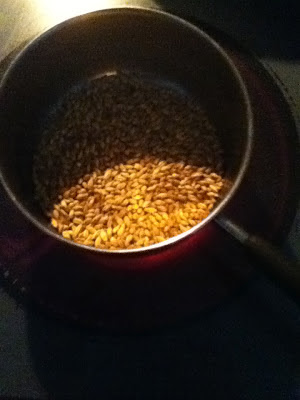


 I like the oven better for evenness and cleanness. Next time, I'll use the oven.
My wife has a super-awesome cast-iron pot I could use, too, but I'm sort of afraid I'll be the one who damages the enamel finish first. I would be that guy, in our household!
Oven. Definitely the oven.
I like the oven better for evenness and cleanness. Next time, I'll use the oven.
My wife has a super-awesome cast-iron pot I could use, too, but I'm sort of afraid I'll be the one who damages the enamel finish first. I would be that guy, in our household!
Oven. Definitely the oven.


Subscribe to:
Posts (Atom)